Showing posts with label 5G NR RRC states. Show all posts

Saturday, February 8, 2020

5G NR (SIB-1 TO SIB -9) System information blocks


System information blocks


SIB1

SIB1 contains information relevant when evaluating if a UE is allowed to access a cell and defines the scheduling of other system information.It also contains radio resource configuration information that is common for all UEs and barring information applied to the unified access control.
Signalling radio bearer: N/A
RLC-SAP: TM
Logical channels: BCCH
Direction: Network to UE


SIB2

SIB2 contains cell re-selection information common for intra-frequency, inter-frequency and/or inter-RAT cell re-selection.
 (i.e. applicable for more than one type of cell re-selection but not necessarily all) as well as intra-frequency cell re-selection information other than neighbouring cell related.


SIB3

SIB3 contains neighbouring cell related information relevant only for intra-frequency cell re-selection. The IE includes cells with specific re-selection parameters as well as blacklisted cells.


SIB4
     
SIB4 contains information relevant only for inter-frequency cell re-selection i.e. information about other NR frequencies and inter-frequency neighbouring cells relevant for cell re-selection. The IE includes cell re-selection parameters common for a frequency as well as cell specific re-selection parameters.


 SIB5

SIB5 contains information relevant only for inter-RAT cell re-selection i.e. information about E-UTRA frequencies and E-UTRAs neighbouring cells relevant for cell re-selection. The IE includes cell re-selection parameters common for a frequency.

SIB6


SIB6 contains an ETWS primary notification.


SIB7

SIB7 contains an ETWS secondary notification.


SIB8
SIB8 contains a CMAS notification.


SIB9
SIB9 contains information related to GPS time and Coordinated Universal Time (UTC). The UE may use the parameters provided in this system information block to obtain the UTC, the GPS and the local time.
NOTE:    The UE may use the time information for numerous purposes, possibly involving upper layers e.g. to assist GPS initialisation, to synchronise the UE clock.


5G NR (SIB-1 TO SIB -9) System information blocks


System information blocks


SIB1

SIB1 contains information relevant when evaluating if a UE is allowed to access a cell and defines the scheduling of other system information.It also contains radio resource configuration information that is common for all UEs and barring information applied to the unified access control.
Signalling radio bearer: N/A
RLC-SAP: TM
Logical channels: BCCH
Direction: Network to UE


SIB2

SIB2 contains cell re-selection information common for intra-frequency, inter-frequency and/or inter-RAT cell re-selection.
 (i.e. applicable for more than one type of cell re-selection but not necessarily all) as well as intra-frequency cell re-selection information other than neighbouring cell related.


SIB3

SIB3 contains neighbouring cell related information relevant only for intra-frequency cell re-selection. The IE includes cells with specific re-selection parameters as well as blacklisted cells.


SIB4
     
SIB4 contains information relevant only for inter-frequency cell re-selection i.e. information about other NR frequencies and inter-frequency neighbouring cells relevant for cell re-selection. The IE includes cell re-selection parameters common for a frequency as well as cell specific re-selection parameters.


 SIB5

SIB5 contains information relevant only for inter-RAT cell re-selection i.e. information about E-UTRA frequencies and E-UTRAs neighbouring cells relevant for cell re-selection. The IE includes cell re-selection parameters common for a frequency.

SIB6


SIB6 contains an ETWS primary notification.


SIB7

SIB7 contains an ETWS secondary notification.


SIB8
SIB8 contains a CMAS notification.


SIB9
SIB9 contains information related to GPS time and Coordinated Universal Time (UTC). The UE may use the parameters provided in this system information block to obtain the UTC, the GPS and the local time.
NOTE:    The UE may use the time information for numerous purposes, possibly involving upper layers e.g. to assist GPS initialisation, to synchronise the UE clock.




Thursday, January 30, 2020

LTE E-UTRAN FUNCTIONS AND ARCHITECTURE


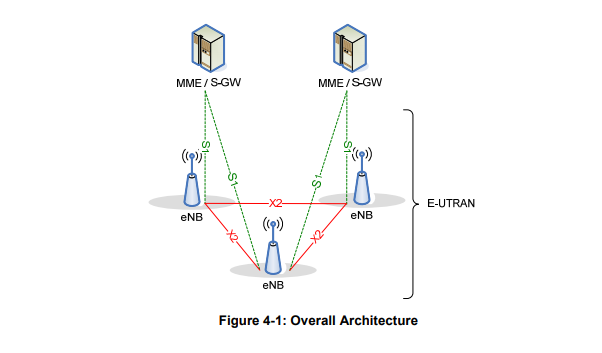
E-UTRAN ARCHITECTURE

The E-UTRAN consists of eNBs:-

  • Providing the E-UTRA user plane (PDCP/RLC/MAC/PHY) and control plane (RRC) protocol terminations towards the UE. 
  • The eNBs are interconnected with each other by means of the X2 interface. 
  • The eNBs are also connected by means of the S1 interface to the EPC (Evolved Packet Core),
  • The MME (Mobility Management Entity) by means of the S1-MME and to the Serving Gateway (S-GW) by means of the S1-U. 
  • The S1 interface supports a many-to-many relation between MMEs / Serving Gateways and eNBs. 


The eNB  functions: - 

  • Radio Resource Management
  • Radio Bearer Control,
  • Radio Admission Control,
  • Connection Mobility Control,
  • Dynamic allocation of resources to UEs in both uplink and downlink (scheduling);
  • Routing of User Plane data towards Serving Gateway;
  • Measurement
  • reporting configuration 
3GPP references- TS 36.300 version 9.6.0 Release 9

Note: Hope you find this information beneficial. If engaged, please share and do not forget to like to us.

LTE E-UTRAN FUNCTIONS AND ARCHITECTURE


E-UTRAN ARCHITECTURE

The E-UTRAN consists of eNBs:-

  • Providing the E-UTRA user plane (PDCP/RLC/MAC/PHY) and control plane (RRC) protocol terminations towards the UE. 
  • The eNBs are interconnected with each other by means of the X2 interface. 
  • The eNBs are also connected by means of the S1 interface to the EPC (Evolved Packet Core),
  • The MME (Mobility Management Entity) by means of the S1-MME and to the Serving Gateway (S-GW) by means of the S1-U. 
  • The S1 interface supports a many-to-many relation between MMEs / Serving Gateways and eNBs. 


The eNB  functions: - 

  • Radio Resource Management
  • Radio Bearer Control,
  • Radio Admission Control,
  • Connection Mobility Control,
  • Dynamic allocation of resources to UEs in both uplink and downlink (scheduling);
  • Routing of User Plane data towards Serving Gateway;
  • Measurement
  • reporting configuration 
3GPP references- TS 36.300 version 9.6.0 Release 9

Note: Hope you find this information beneficial. If engaged, please share and do not forget to like to us.

Wednesday, January 29, 2020

LTE PBCH

LTE Physical Broadcast Channel (PBCH)


  • Physical Broadcast Channel (PBCH) is used to broadcast the Master Information Block (MIB) using the BCH transport channel and BCCH logical channel
  • For both FDD and TDD,
  • the PBCH is allocated the central 72 subcarriers belonging to the first 4 OFDMA symbols of the second time slot of every 10 ms radio frame (time slot 1 in subframe 0, with time slot numbering starting from 0)
  • Reference Signal Resource Elements (including those which would be allocated if antenna ports 0 to 3 were used, irrespective of the actual antenna ports used) are excluded from the PBCH allocation
  •  The PBCH can be broadcast using only antenna port 0, or transmit diversity can be used to broadcast the PBCH using antenna ports {0, I} or {0, I, 2, 3}
Resource Element allocation for the PBCH


normal cyclic prefix:-
  • The PBCH occupies 240 Resource Elements when using the normal cyclic prefix,i.e. (72 x 4)- 48, where 48 is the number of Resource Elements allocated to the Reference Signal.
extended cyclic prefix:-
  • The PBCH occupies 216 Resource Elements when using the extended cyclic prefix, i.e. (72 x 4) - 72, where 72 is the number of Resource Elements allocated to the Reference Signal (in this case, the third column of Reference Signals also overlaps with the set of PBCH Resource Elements)

modulation:-
  • The PBCH uses QPSK modulation so the 240 Resource Elements provide 480 bits when using the normal cyclic prefix, and the 216 Resource Elements provide 432 bits when using the extended cyclic prefix


* 3GPP References: TS 36.211
Note: Hope you find this information beneficial. If engaged, please share and do not forget to like to us.


LTE PBCH

LTE Physical Broadcast Channel (PBCH)


  • Physical Broadcast Channel (PBCH) is used to broadcast the Master Information Block (MIB) using the BCH transport channel and BCCH logical channel
  • For both FDD and TDD,
  • the PBCH is allocated the central 72 subcarriers belonging to the first 4 OFDMA symbols of the second time slot of every 10 ms radio frame (time slot 1 in subframe 0, with time slot numbering starting from 0)
  • Reference Signal Resource Elements (including those which would be allocated if antenna ports 0 to 3 were used, irrespective of the actual antenna ports used) are excluded from the PBCH allocation
  •  The PBCH can be broadcast using only antenna port 0, or transmit diversity can be used to broadcast the PBCH using antenna ports {0, I} or {0, I, 2, 3}
Resource Element allocation for the PBCH


normal cyclic prefix:-
  • The PBCH occupies 240 Resource Elements when using the normal cyclic prefix,i.e. (72 x 4)- 48, where 48 is the number of Resource Elements allocated to the Reference Signal.
extended cyclic prefix:-
  • The PBCH occupies 216 Resource Elements when using the extended cyclic prefix, i.e. (72 x 4) - 72, where 72 is the number of Resource Elements allocated to the Reference Signal (in this case, the third column of Reference Signals also overlaps with the set of PBCH Resource Elements)

modulation:-
  • The PBCH uses QPSK modulation so the 240 Resource Elements provide 480 bits when using the normal cyclic prefix, and the 216 Resource Elements provide 432 bits when using the extended cyclic prefix


* 3GPP References: TS 36.211
Note: Hope you find this information beneficial. If engaged, please share and do not forget to like to us.


Tuesday, January 28, 2020

5G NR RRC states


5G NR UE RRC States IDLE, INACTIVE, CONNECTED

The 5G NR UE states are RRC_IDLE, RRC_INACTIVE and RRC_CONNECTED mode.

UE states and state transitions including inter RAT
A UE is either in RRC_CONNECTED state or in RRC_INACTIVE state when an RRC connection has been established.
If this is not the case, i.e. no RRC connection is established, the UE is in RRC_IDLE state.

The RRC states can further be characterised as follows:-
UE RRC state machine and state transitions in NR. A UE has only one RRC state in NR at one time.

UE RRC state machine and state transitions in NR


UE RRC state machine and state transitions berween NR/5G, E-UTRAN/EPC

RRC_IDLE: -
  • UE specific DRX may be configured by upper layers
  • UE controlled mobility based on network configuration; -
  • Paging
  • PLMN selection
  • Broadcast of system information
  • Cell re-selection mobility

RRC_INACTIVE: -
  • Broadcast of system information
  • Cell re-selection mobility
  • Paging is initiated by NG-RAN (RAN paging)
  • DRX for RAN paging configured by NG-RAN
  • 5GC to NG-RAN connection (both C/U-planes) is established for UE
  • The UE AS context is stored in NG-RAN and the UE
  • NG-RAN knows the RNA which the UE belongs to

RRC_CONNECTED: -
  • 5GC – NG-RAN connection (both C/U-planes) is established for UE
  • The UE AS context is stored in NG-RAN and the UE
  • NG-RAN knows the cell which the UE belongs to
  • Transfer of unicast data to/from the UE
  • Network controlled mobility including measurements.


Reference: 3GPP TS 38.300.
Note: Hope you find this information beneficial. If  engaged, please share and do not forget to Like to us


5G NR RRC states


5G NR UE RRC States IDLE, INACTIVE, CONNECTED

The 5G NR UE states are RRC_IDLE, RRC_INACTIVE and RRC_CONNECTED mode.

UE states and state transitions including inter RAT
A UE is either in RRC_CONNECTED state or in RRC_INACTIVE state when an RRC connection has been established.
If this is not the case, i.e. no RRC connection is established, the UE is in RRC_IDLE state.

The RRC states can further be characterised as follows:-
UE RRC state machine and state transitions in NR. A UE has only one RRC state in NR at one time.

UE RRC state machine and state transitions in NR


UE RRC state machine and state transitions berween NR/5G, E-UTRAN/EPC

RRC_IDLE: -
  • UE specific DRX may be configured by upper layers
  • UE controlled mobility based on network configuration; -
  • Paging
  • PLMN selection
  • Broadcast of system information
  • Cell re-selection mobility

RRC_INACTIVE: -
  • Broadcast of system information
  • Cell re-selection mobility
  • Paging is initiated by NG-RAN (RAN paging)
  • DRX for RAN paging configured by NG-RAN
  • 5GC to NG-RAN connection (both C/U-planes) is established for UE
  • The UE AS context is stored in NG-RAN and the UE
  • NG-RAN knows the RNA which the UE belongs to

RRC_CONNECTED: -
  • 5GC – NG-RAN connection (both C/U-planes) is established for UE
  • The UE AS context is stored in NG-RAN and the UE
  • NG-RAN knows the cell which the UE belongs to
  • Transfer of unicast data to/from the UE
  • Network controlled mobility including measurements.


Reference: 3GPP TS 38.300.
Note: Hope you find this information beneficial. If  engaged, please share and do not forget to Like to us


Monday, January 27, 2020

5G Protocol Stack - User Plane/Control Plane

NR 5G Protocol Stack - User Plane/Control Plane


NR User Plane Protocol Stack  is shown in below figures,

User Plane


NR Control Plane Protocol Stack  is shown in below figures


Control Plane 

SDAP (Service Data Adaptation Protocol)
RRC(Radio Resource control)
PDCP (Packet Data Convergence Protocol)
RLC (Radio Link Control )
MAC (Media Access Control)

Functions :-

SDAP functions:-
  • transfer of user plane data
  • mapping between a QoS flow and a DRB for both DL and UL 
  • marking QoS flow ID in both DL and UL packets
  • reflective QoS flow to DRB mapping for the UL SDAP data PDUs.

PDCP  functions: -
  • transfer of data (user plane or control plane)
  • maintenance of PDCP SNs
  • header compression and decompression using the ROHC
  • ciphering and deciphering
  • integrity protection and integrity verification
  • timer based SDU discard
  • reordering and in-order delivery
  • duplicate discarding.

RLC functions:-
  • transfer of upper layer PDUs
  • error correction through ARQ (only for AM data transfer) segmentation and reassembly of RLC SDUs
  • re-segmentation of RLC SDU segments
  • duplicate detection (only for AM data transfer)
  • RLC SDU discard (only for UM and AM data transfer)
  • RLC re-establishment
  • Protocol error detection (only for AM data transfer). 


MAC functions: -
  • mapping between logical channels and transport channels.
  • multiplexing/ de-multiplexing of MAC SDUs.
  • scheduling information reporting.
  • error correction through HARQ.
  • logical channel prioritisation.


RRC functions: -
  • Broadcast of system information.
  • RRC connection control.
  • Paging.
  • Establishment/modification/suspension/resumption/release of RRC connection, establishment/modification/suspension/resumption/release of SRBs/ DRBs (except for SRB0).
  • Access barring.
  • Initial security activation.
  • mobility control.
  • Radio configuration control including e.g. assignment/modification of ARQ. configuration, HARQ configuration, DRX configuration.
  • QoS management functions.
  • Recovery from radio link failure.
  • Establishment/modification/release of measurement configuration.
  • Setup and release of measurement gaps; - Measurement reporting. 


3GPP references : 38.331 V15.3.0 (2018-10)
Note: Hope you find this information beneficial. If engaged, please share and do not forget to like to us.


5G Protocol Stack - User Plane/Control Plane

NR 5G Protocol Stack - User Plane/Control Plane


NR User Plane Protocol Stack  is shown in below figures,

User Plane


NR Control Plane Protocol Stack  is shown in below figures


Control Plane 

SDAP (Service Data Adaptation Protocol)
RRC(Radio Resource control)
PDCP (Packet Data Convergence Protocol)
RLC (Radio Link Control )
MAC (Media Access Control)

Functions :-

SDAP functions:-
  • transfer of user plane data
  • mapping between a QoS flow and a DRB for both DL and UL 
  • marking QoS flow ID in both DL and UL packets
  • reflective QoS flow to DRB mapping for the UL SDAP data PDUs.

PDCP  functions: -
  • transfer of data (user plane or control plane)
  • maintenance of PDCP SNs
  • header compression and decompression using the ROHC
  • ciphering and deciphering
  • integrity protection and integrity verification
  • timer based SDU discard
  • reordering and in-order delivery
  • duplicate discarding.

RLC functions:-
  • transfer of upper layer PDUs
  • error correction through ARQ (only for AM data transfer) segmentation and reassembly of RLC SDUs
  • re-segmentation of RLC SDU segments
  • duplicate detection (only for AM data transfer)
  • RLC SDU discard (only for UM and AM data transfer)
  • RLC re-establishment
  • Protocol error detection (only for AM data transfer). 


MAC functions: -
  • mapping between logical channels and transport channels.
  • multiplexing/ de-multiplexing of MAC SDUs.
  • scheduling information reporting.
  • error correction through HARQ.
  • logical channel prioritisation.


RRC functions: -
  • Broadcast of system information.
  • RRC connection control.
  • Paging.
  • Establishment/modification/suspension/resumption/release of RRC connection, establishment/modification/suspension/resumption/release of SRBs/ DRBs (except for SRB0).
  • Access barring.
  • Initial security activation.
  • mobility control.
  • Radio configuration control including e.g. assignment/modification of ARQ. configuration, HARQ configuration, DRX configuration.
  • QoS management functions.
  • Recovery from radio link failure.
  • Establishment/modification/release of measurement configuration.
  • Setup and release of measurement gaps; - Measurement reporting. 


3GPP references : 38.331 V15.3.0 (2018-10)
Note: Hope you find this information beneficial. If engaged, please share and do not forget to like to us.


3GPP Release 9 – Date 2009

3GPP Release 9 – Date 2009 Release 9 brought a number of refinements to features introduced in Release 8, along with new developments to the...